Educational game about ceramic
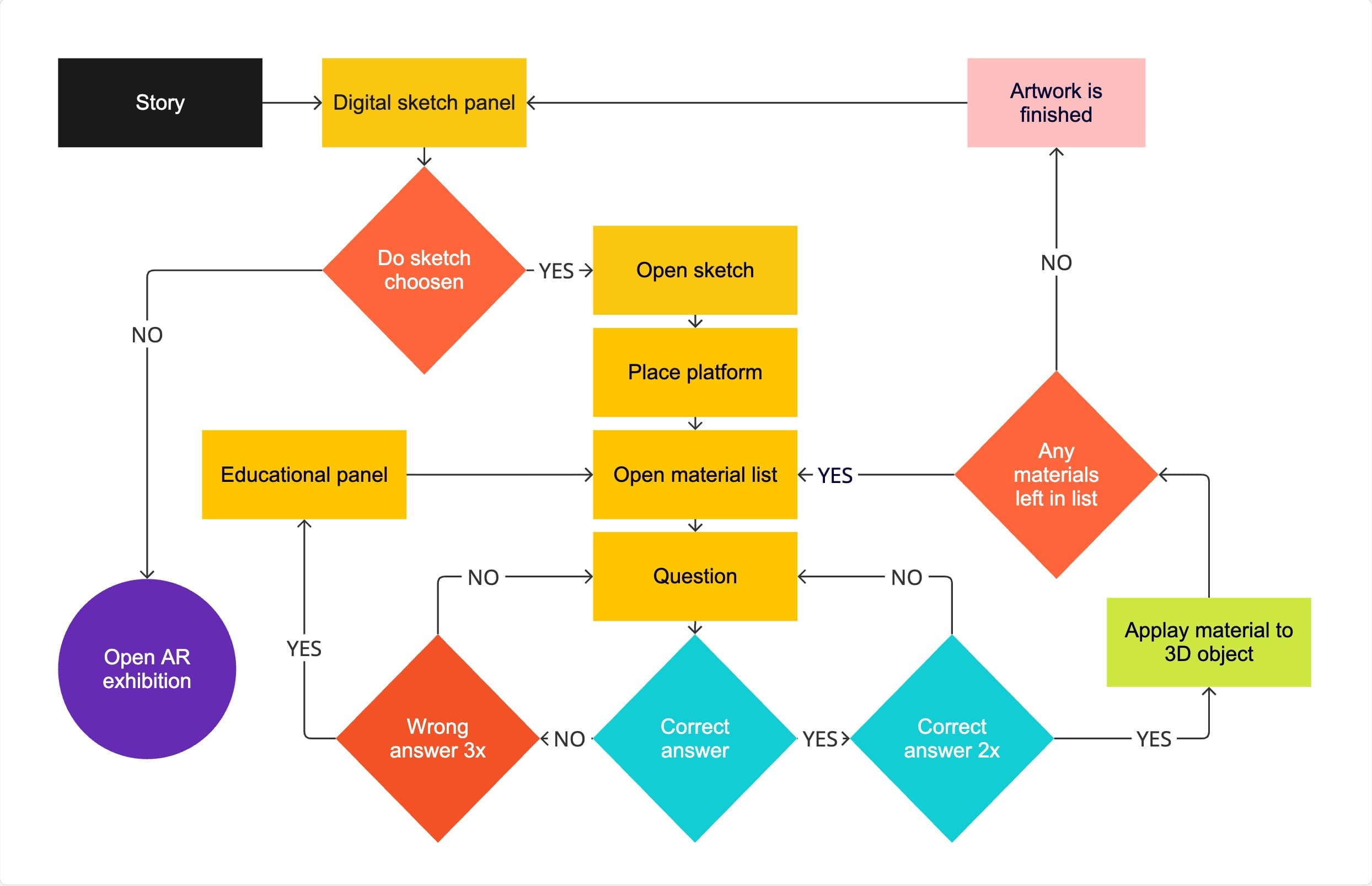
The project is an educational augmented reality game developed to teach the processes, materials, and artistic concepts of contemporary ceramics. The game utilizes detailed 3D models of ceramic artworks, created using photogrammetry to replicate the textures and forms of original physical objects, placing them directly into the player’s real-world environment.
The gameplay is structured around active learning through progression and creation. The experience begins with an introduction that presents the core narrative and game concept. Following this, a digital sketch panel opens, showcasing five distinct digital artwork sketches waiting to be transformed. The player selects a sketch and uses their phone’s camera to scan a horizontal surface (identified by a visual blue indicator). Once placed, a digital ceramic workshop platform – highlighted by a light blue circle – levitates in the space, marked by a dynamic, purple plasma flame.
Interactive elements on the platform reveal the schematic digital sketch of the artwork and a materials list. Selecting a material initiates a learning-based challenge: a multiple-choice quiz about that material appears. Correct answers (highlighted in green) progress the player to subsequent questions. Answering two consecutive questions correctly triggers the creative transformation: the schematic 3D sketch begins to materialize, gaining the realistic texture and appearance of the chosen material, such as clay or porcelain.
If a player provides three incorrect answers for a single artwork, they are offered assistance. A “training panel” presents detailed text-based descriptions of all materials, processing techniques, and terms used in the game, empowering the player with the knowledge required to proceed. Closing this panel restarts the creation and material selection process for the current sketch, clearing previous correct/incorrect counts.
Once all five sketches are successfully transformed into finalized contemporary ceramic artworks, an “AR Exhibition” button becomes active. Opening this feature initiates a spatial scanning sequence. Similar to the platform placement, players look for blue indicators representing detected planes, but this time, artworks can also be positioned on vertical surfaces. A panel featuring the completed collection appears on the screen, alongside a confirmation button. Players select an artwork from the panel, and once satisfied with its placement on a detected plane, they confirm its location, making it a permanent feature of that AR session.
When the player is finished arranging their virtual gallery, pressing a “Completed” button hides all interface elements, offering a clear, undisturbed view of their created AR exhibition. The core aim of the game is to foster a deeper appreciation and knowledge of contemporary ceramics by making the viewer an active creator rather than a mere observer, dissolving the boundaries between physical space and digital learning, and transforming the process of curation and artistic understanding into an engaging, participatory experience.
This educational game was developed as a Master’s degree thesis project. It serves as a practical application of game design and augmented reality technology within the context of fine arts education, aiming to innovate instructional methods for complex, material-based art forms. The objects integrated into the game were scanned using photogrammetry.
Creator holds the role of the primary researcher, game designer, and developer for this project, leading its conception from pedagogical theory through full technical realization in Unity, including the integration of photogrammetry models and the creation of the augmented reality experience.